
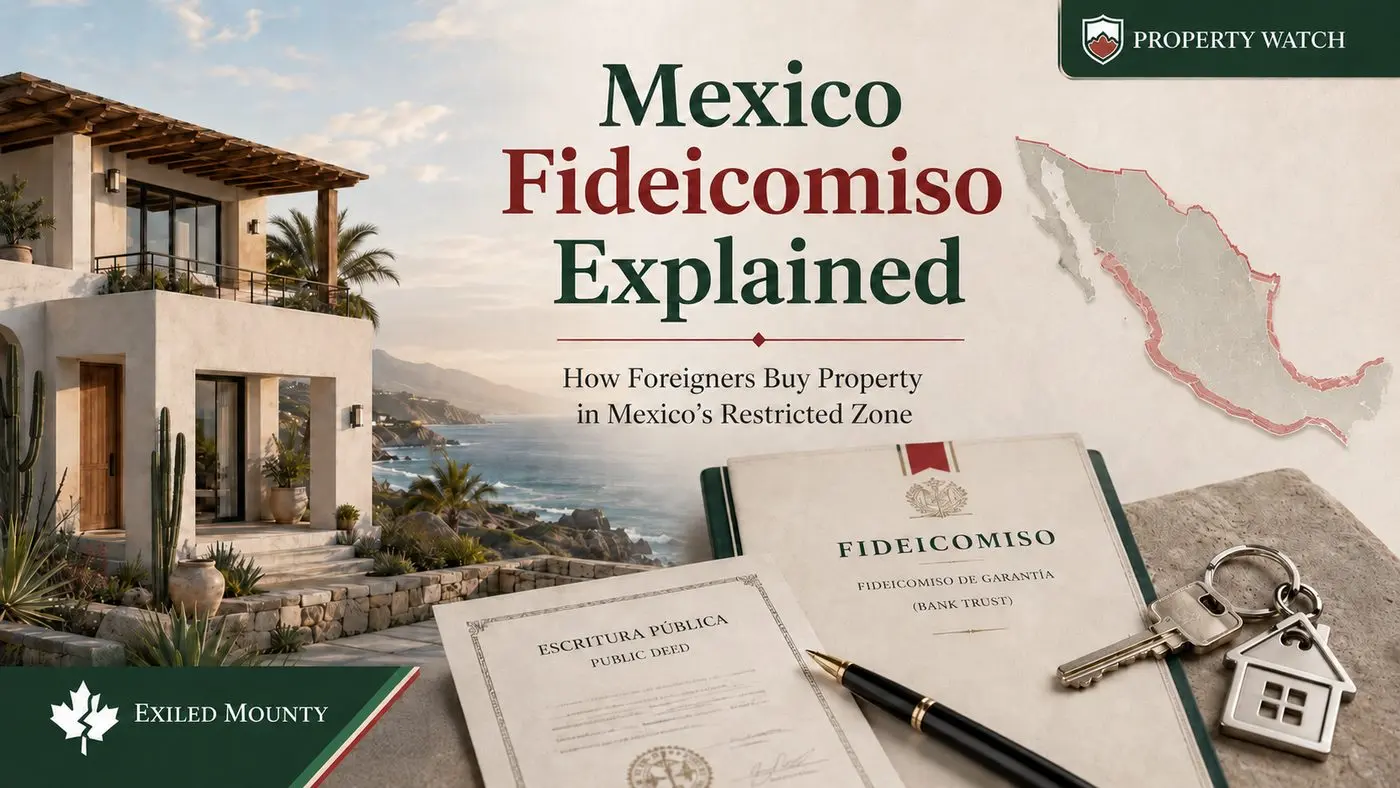
Foreigners can buy property in Mexico. That part is true.
But in much of the country foreigners actually want, including beaches, border areas, resort towns, and expat corridors, the legal structure does not always work the way Canadians and Americans expect.
That is where the fideicomiso comes in.
A fideicomiso is not a loophole, a handshake deal, or some back-alley workaround cooked up by a real estate agent with nice shoes and suspiciously perfect English. It is the legal structure foreign buyers commonly use to hold beneficiary rights to the use and enjoyment of residential real estate inside Mexico's restricted zone.
The problem is not the fideicomiso itself.
The problem is buying before you understand what it does, what it does not do, what it costs, who controls what, and when someone is trying to sell you a shortcut that should send you straight back to your hotel.
This guide explains the Mexico fideicomiso in plain English: what it is, when foreigners need one, what rights it gives you, and the red flags foreign buyers should check before signing anything.
The Short Answer
Foreigners can buy in Mexico, including in coastal and border areas.
But individual foreign buyers purchasing residential property inside Mexico's restricted zone usually do not hold direct title in their own name. Instead, they commonly use a fideicomiso.
A fideicomiso is a Mexican bank trust.
A Mexican bank holds legal title as trustee. The foreign buyer is the beneficiary of the trust. In practical terms, the buyer can generally use the property, improve it, rent it where legally permitted, sell the beneficiary rights, and name substitute beneficiaries or heirs, subject to the trust terms and Mexican law.
This is not a casual workaround. It is a formal legal structure recognized under Mexico's property and foreign investment framework.
The bank is not your landlord. The bank does not live in your house. The bank does not choose your paint colors, approve your barbecue, or tell your mother-in-law she can stay another month.
But the bank is part of the legal structure. That means the trust documents, fees, beneficiary language, renewal terms, and transfer process all have consequences.
What Is Mexico's Restricted Zone?
Mexico's restricted zone covers land within:
- 50 kilometres of the coast
- 100 kilometres of an international border
That includes many places foreign buyers care about: Riviera Maya, Puerto Vallarta, Los Cabos, Baja California, parts of Yucatan, Tulum, Playa del Carmen, Mazatlan, Puerto Escondido, and border-region markets.
Under Mexico's constitutional framework, foreigners are restricted from acquiring direct ownership of land and water in this zone. Mexico's Secretariat of Foreign Affairs, the SRE, describes the restricted area as the strip of 100 kilometres along borders and 50 kilometres along beaches, where foreigners may use and enjoy real estate through a fideicomiso structure.
Outside the restricted zone, foreigners may be able to hold direct title. But that does not mean the deal is automatically clean.
Direct title still requires due diligence, notary involvement, legal review, tax review, registration checks, and a clear understanding of the property's legal status. "Outside the restricted zone" is not a magic blessing. It is only one box in the purchase package.
What Is A Fideicomiso?
A fideicomiso is a bank trust used to allow foreign buyers the use and enjoyment of real estate in Mexico's restricted zone.
The basic structure looks like this:
- The property is placed into a trust structure with a Mexican bank acting as trustee.
- The foreign buyer becomes the beneficiary.
- The buyer receives beneficiary rights under the trust agreement.
The bank holds legal title as trustee. The foreign buyer holds rights as beneficiary under the trust. That distinction counts.
Some people explain this badly and make it sound like the bank owns your house and you are just borrowing it. That is not the right way to think about it.
The bank is the trustee. It holds title according to the trust agreement. The foreign buyer, as beneficiary, normally has the practical and economic benefits attached to the property.
Under Mexico's Foreign Investment Law, the fideicomiso permits use and enjoyment of restricted-zone real estate by foreign beneficiaries, without giving the foreign beneficiary direct real-property ownership in the restricted zone.
That is why the trust agreement needs to be read, not waved around like a lucky napkin.
Is A Fideicomiso Real Ownership Or Just A Lease?
A fideicomiso is not a lease.
This is one of the most common points of confusion for foreign buyers.
A lease means you are renting from someone else for a set term. A fideicomiso is different. The foreign buyer is usually the beneficiary of a trust and can generally exercise rights that look much closer to ownership than tenancy.
Depending on the trust terms and applicable law, the beneficiary can usually:
- Use the property
- Occupy the property
- Improve the property
- Rent the property where legally permitted
- Sell beneficiary rights
- Transfer rights
- Name substitute beneficiaries
- Pass rights to heirs
That said, do not oversimplify it as identical to direct title in Canada or the United States.
A fideicomiso is a legal holding structure, not a rental arrangement. But because title is held through a bank trust, foreign buyers need to understand the trust terms, bank fees, renewal process, beneficiary rights, and transfer mechanics before buying.
If someone tells you, "It is exactly the same as owning back home," slow down.
If someone tells you, "You do not really own anything," slow down too.
The truth is in the documents.
When Do Foreigners Need A Fideicomiso?
Foreign individuals usually need a fideicomiso when buying residential property inside Mexico's restricted zone.
Common examples include:
- A beach house in Yucatan
- A condo in Playa del Carmen
- A property in Puerto Vallarta
- A home in Los Cabos
- A coastal lot in Oaxaca
- A property near the U.S. border
- A resort-area apartment in a restricted-zone market
The question is not just, "Can foreigners buy property in Mexico?"
The better question is:
Where is the property, what is its legal status, and what structure is being used?
That question catches more problems than the usual sales-office answer.
A property may be inside the restricted zone. It may be private titled land. It may already be held in an existing fideicomiso. It may require a new trust. It may be marketed as clean when the documents say something else.
Or it may be ejido land, which is a different conversation entirely and one foreign buyers should not stumble into casually.
How Long Does A Fideicomiso Last?
Fideicomisos for restricted-zone property are commonly established for up to 50 years and can generally be renewed.
The 50-year term should not panic you. It should also not be ignored.
A fideicomiso is not something to forget until year 49, when someone finds a dusty folder behind the blender and realizes the bank contact no longer works there.
Buyers should keep the trust paperwork organized from day one.
That record should include:
- Trust deed
- SRE permit or related permit documentation
- Bank trustee details
- Annual trustee fee records
- Renewal dates
- Substitute beneficiary information
- Property description
- Registration details
- Notary documents
- Sale and transfer procedure
- Contact details for the bank and professionals involved
If your Plan B depends on a property, treat the paperwork like part of the asset. Because it is.
What Does A Fideicomiso Cost?
There is no single universal fideicomiso cost that applies cleanly to every property, bank, state, and transaction.
Anyone giving you one neat number without asking about the property, bank, location, existing trust, closing structure, and professional fees is probably selling simplicity, not accuracy.
Cost categories may include:
- SRE permit fee
- Bank trust setup fee
- Annual bank trustee fee
- Notary fees
- Public registry fees
- Legal review
- Closing costs and acquisition taxes
- Translation or document costs
- Possible bank transfer or administrative charges
The purchase price is not the full cost of buying in Mexico.
A fideicomiso adds setup and annual costs, and those costs should be priced into the deal before you fall in love with the rooftop terrace.
This is where foreign buyers get sloppy. They compare listing prices, not full acquisition costs. Then closing comes, the paperwork gets thicker, fees appear, and suddenly the "cheap Mexico property" has more moving parts than expected.
Who Controls The Property?
The foreign buyer, as beneficiary, usually controls the practical and economic benefits of the property, subject to the trust agreement and Mexican law.
The buyer can typically occupy the property, rent it where legally permitted, improve it, and transfer or sell beneficiary rights, subject to the trust agreement and Mexican law.
But the bank is still part of the structure.
Before buying, confirm:
- Which bank is trustee
- Whether the trust is new or existing
- Annual trustee fees
- Renewal terms
- Substitute beneficiary language
- Sale and transfer procedure
- Whether the trust covers the exact property being purchased
- Whether the seller has authority to sell
- Whether the existing trust is clean and transferable
- Whether the legal description matches the actual property
Do not rely on the agent's summary. Do not rely on the seller's memory. Do not rely on "the bank has it all."
Read the documents.
If you cannot read Spanish legal paperwork, hire someone independent who can.
Fideicomiso Vs Mexican Corporation
Foreign buyers also hear about Mexican corporations.
This is where the advice often gets lazy.
For personal residential use inside the restricted zone, a fideicomiso is often the normal route for foreign individuals.
A Mexican corporation may be used in some business, commercial, development, or investment contexts. But it is not a magic shortcut for every foreign buyer.
If someone tells you to use a corporation without asking whether the property is residential, commercial, rental-focused, tax-sensitive, part of a business plan, or intended for personal use, slow down.
That is not advice. That is a sales funnel wearing a blazer.
A corporation can bring accounting obligations, tax consequences, legal maintenance, compliance duties, and business-purpose questions. It may be useful in the right case. It may be the wrong tool in another.
The structure should fit the property and the buyer's actual plan.
Not the commission timeline.
Common Fideicomiso Red Flags
The fideicomiso is usually not the danger.
The messy paper trail is the danger.
Watch for these red flags:
- An agent says "you do not need a fideicomiso" for coastal or border property without explaining why.
- The seller says "we can do it privately."
- The property is ejido land.
- Existing trust documents are missing.
- The trust documents are unclear or incomplete.
- Beneficiaries are not properly named.
- The trust does not match the property being sold.
- Bank fees are undisclosed.
- Notary review is skipped or minimized.
- You are pressured to wire funds before due diligence.
- The property is marketed as "titled" but the documents show something else.
- The seller promises easy rental income without discussing taxes, permits, platform rules, or HOA restrictions.
- Nobody can clearly explain whether the property is inside the restricted zone.
- The property description in the trust does not match what you think you are buying.
- The seller cannot show authority to transfer rights.
- The notary is treated like a rubber stamp instead of a serious part of the closing record.
One red flag does not always mean the deal is dead.
But it does mean the deal slows down.
Mexico rewards patience. It does not reward panic buying, sunset fever, or wiring money because an agent said three other Canadians are interested.
Where Foreign Buyers Get Into Trouble
Foreign buyers usually do not get into trouble because the word fideicomiso is too complicated.
They get into trouble because they want Mexico to work like home.
The deal moves fast. The agent sounds confident. The seller has a story. The notary is assumed to be "basically the lawyer." The bank trust is treated like a safety inspection. A clean listing photo starts to feel like a clean title record.
Then someone says, "Everyone does it this way."
That is the line where the clock should stop.
A fideicomiso can be a normal, workable structure. But it still sits inside a larger purchase package: land status, title history, notary review, tax obligations, bank fees, inheritance planning, municipal rules, HOA rules, rental rules, utilities, access, and exit strategy.
If you do not understand the paperwork, you do not understand the deal.
Due Diligence Checklist Before Buying Through A Fideicomiso
Before buying property through a fideicomiso, foreign buyers should confirm the basics.
Start here:
- Confirm whether the property is inside Mexico's restricted zone.
- Confirm whether the property is titled private property.
- Rule out ejido land unless you fully understand the risk and have serious specialist advice.
- Review the existing deed or trust.
- Confirm the seller's authority to sell.
- Use an independent lawyer.
- Use a qualified notary.
- Confirm which bank is trustee.
- Confirm bank trustee setup and annual fees.
- Confirm closing costs and taxes.
- Confirm registration process.
- Confirm substitute beneficiary or inheritance language.
- Confirm whether rentals are legally permitted.
- Confirm tax obligations if renting.
- Confirm HOA rules for condos or gated communities.
- Confirm utility status, water, access, and municipal issues.
- Do not wire large funds before documentation is reviewed.
This is not glamorous work.
Good.
Glamour is how people get sold the dream. Paperwork is how they avoid buying the problem.
Mounty's Read
The fideicomiso is not the monster under the bed.
For many foreign buyers, it is simply the structure Mexico uses to let foreigners use and enjoy real estate in places where direct title is restricted.
But it is also not a detail to wave away.
If you are buying in Mexico's restricted zone, the fideicomiso is part of the purchase package. Understand it before you buy, not after the deposit has left your account and the agent has suddenly become harder to reach.
Mexico can be a strong property flag.
A beach town, a second base, a rental option, a retirement plan, a family landing pad, or a hedge against whatever nonsense is unfolding back home.
But do not plant it blind.
The restricted zone is not automatically dangerous. A fideicomiso is not automatically suspicious. A bank trust is not automatically safe.
The deal is only as strong as the paper trail behind it.
Thinking About Buying Property In Mexico?
Start with the basics before you start shopping listings.
Read the Mexico Property Field Guide for a broader look at buying, renting, red flags, due diligence, restricted-zone issues, ejido land, closing costs, and the practical checks foreign buyers should understand before making a move.
If Mexico is part of your wider Plan B, also read the Mexico Temporary Resident Visa guide to understand your legal status options.
And if you are comparing countries, routes, income requirements, or residency pathways, start with the country guides and verify your fit against official sources before you spend money.
Property is not just a purchase.
It is part of the larger picture: residency, banking, taxes, healthcare, family logistics, and exit strategy.
Do the boring checks first. They are cheaper than fixing a bad deal later.
Sources And Verification Points
- Mexico SRE restricted-zone fideicomiso permit guidance: sre.gob.mx/permiso-para-constituir-un-fideicomiso-en-zona-restringida
- SRE permit process for fideicomisos over real estate in the restricted zone: portales.sre.gob.mx
- Official legal text should be verified with current Mexican law and qualified professionals before money moves.
Educational information only. Not legal, real estate, tax, investment, immigration, or financial advice. Verify with qualified Mexican professionals before acting.