
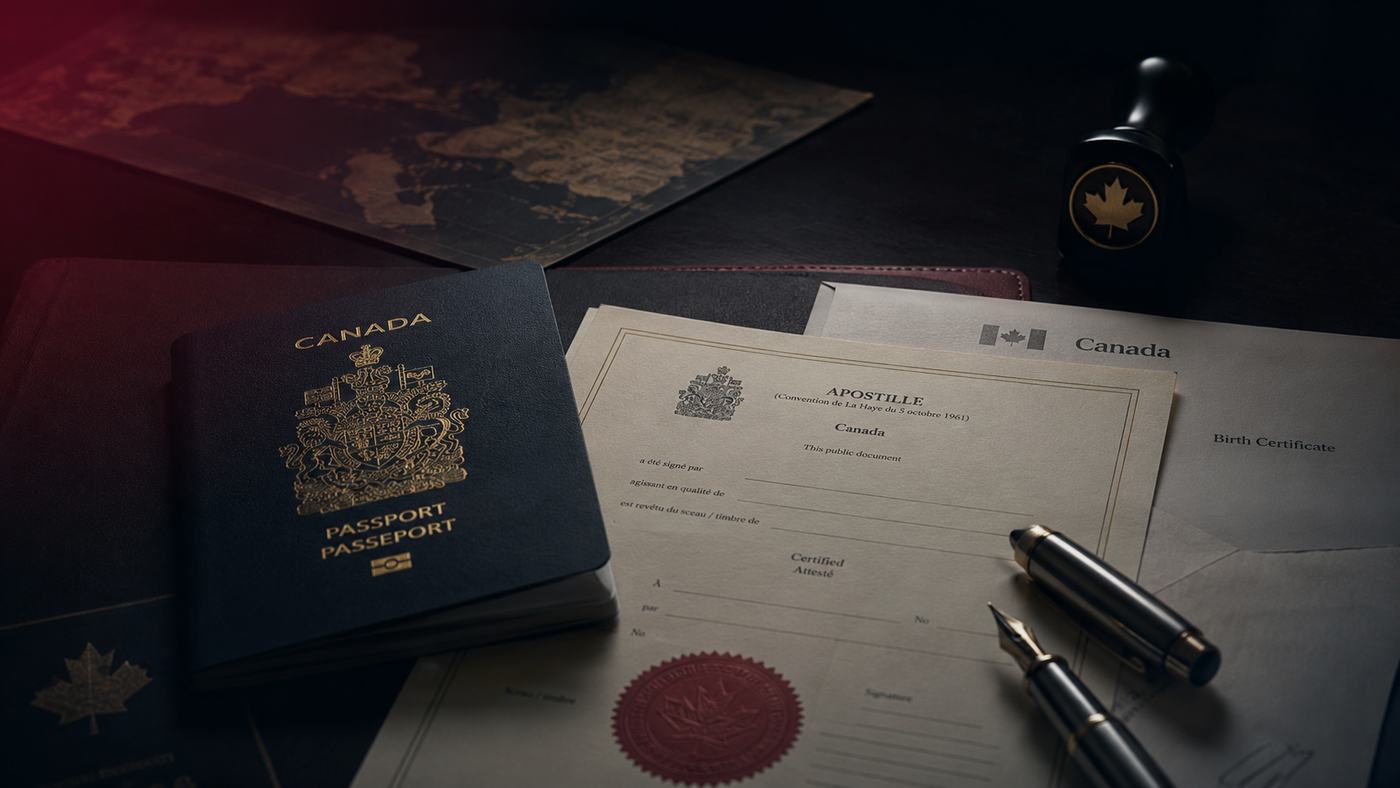
Direct answer: Canada has issued apostilles under the Apostille Convention since January 11, 2024. Federal documents and documents from some provinces or territories go through Global Affairs Canada, while documents issued or notarized in designated provinces go through the relevant provincial competent authority. Confirm the receiving country’s document and freshness rules before mailing originals.
If you are applying for residency abroad, you will probably be asked for Canadian documents that have been "apostilled," "authenticated," or "legalized."
The words sound like government fog, because naturally, government found a way to make a stamp complicated.
Here is the plain version: an apostille proves that the signature, seal, or stamp on a Canadian public document is genuine so a foreign authority can rely on it.
The Apostille Convention came into force for Canada on January 11, 2024, which changed the process for Canadians using documents abroad. For countries that are part of the Apostille Convention, an apostille usually replaces the older two-step process of authentication plus embassy or consular legalization.
In Canada, the government may still call the process "authentication," even when the certificate issued is an apostille.
What Is an Apostille?
An apostille is an official certificate attached to a public document for international use.
It does not prove that every statement inside the document is true. It proves that the public official's signature, seal, or stamp is genuine.
For residency abroad, apostilles are commonly requested for:
- Birth certificates
- Marriage certificates
- Divorce certificates or court documents
- RCMP criminal record checks
- Name change certificates
- University diplomas or transcripts
- Notarized copies of passports or ID
- Powers of attorney, affidavits, or statutory declarations
- Bank, pension, or income documents when required by the destination country
If a foreign immigration office asks for an apostilled Canadian document, they usually want assurance that the document is official and can be accepted outside Canada.
Apostille vs Authentication vs Legalization
These three terms are related, but they are not exactly the same.
Authentication confirms that the signature and seal on a document are genuine.
Legalization is usually the next step for a country that is not part of the Apostille Convention. After Canadian authentication, the foreign embassy, consulate, or high commission may legalize the document for use in that country.
An apostille is a simplified form of authentication used between countries that are members of the Hague Apostille Convention. If the destination country is a member, the apostille should normally be accepted without consular legalization.
Mounty's read: Before spending money, check the exact requirement with the foreign residency office, immigration lawyer, consulate, or receiving authority. Canadian offices do not decide what a foreign country will accept.
Step 1: Confirm the Destination Country's Rules
First, find out whether the country where you plan to use the document is part of the Hague Apostille Convention.
If it is a member country, the receiving authority will usually ask for an apostille instead of the old authentication-plus-legalization chain.
If it is not a member country, you may still need Canadian authentication, followed by legalization through that country's embassy or consulate.
Also confirm whether the foreign authority requires:
- Original documents or notarized copies
- Recent issue dates
- Certified translations
- Federal apostille only, especially for RCMP records
- Separate apostilles for each document
- Documents bundled together or submitted separately
That is where weeks disappear. Some countries are picky. Some consulates are pickier. And some immigration offices seem to change their document mood with the weather.
Step 2: Identify Who Issued or Notarized the Document
This is where Canadians lose time.
You do not always send everything to Global Affairs Canada. Canada has both federal and provincial apostille authorities.
Send documents to Global Affairs Canada if they were issued by the Government of Canada, or if they were issued or notarized in:
- Manitoba
- New Brunswick
- Newfoundland and Labrador
- Nova Scotia
- Prince Edward Island
- Yukon
- Northwest Territories
- Nunavut
Send documents to the provincial authority if they were issued or notarized in:
- Alberta
- British Columbia
- Ontario
- Quebec
- Saskatchewan
One wrinkle: Alberta, Ontario, and Saskatchewan generally follow the province of notarization, while British Columbia and Quebec are more restrictive and usually only handle notarized documents when the original document was issued in that province. Check the provincial rule before mailing anything.
Global Affairs Canada says it will return documents issued or notarized in those provincial competent-authority provinces if they should have gone provincially.
That is the small mistake that turns a clean file into a waiting game.
Step 3: Prepare the Document Correctly
The document must usually have an original recognized signature and seal. Plain photocopies are not accepted.
Some documents do not need notarization, such as many vital statistics certificates and properly issued RCMP criminal record checks. Others usually do need notarization, including private legal documents, bank documents, many identity-document copies, and some school or employment records.
For residency files, watch these traps:
- Short-form or wallet-size birth certificates may be rejected.
- Laminated documents can be rejected.
- Religious birth or marriage certificates usually are not accepted as civil vital records.
- RCMP criminal record checks from Ottawa usually go to Global Affairs Canada.
- Municipal or provincial police checks may need notarization first.
- Documents in languages other than English or French usually need certified translation.
- Older documents may be rejected if the official signature can no longer be verified.
For Canadian vital statistics documents, get fresh official copies when possible. For residency abroad, "good enough" paperwork has a bad habit of becoming "start again."
Step 4: Submit the Apostille Request
For Global Affairs Canada, you can use the online triage portal or manual paper form, but physical documents still have to be mailed.
Global Affairs Canada does not currently charge a government fee for authentication or apostille service.
As of this research, Global Affairs Canada lists processing at 20 business days, plus mailing time, normally 5 to 10 business days if shipped from Canada. It does not offer regular expedited service.
Provincial costs and timelines vary:
- Alberta: $25 per document; allow at least 7 to 10 business days.
- British Columbia: $20 per document; current processing is 2 to 4 weeks, not including mail time.
- Ontario: $16 for notarized legal documents; $32 for Ontario government, court, and public postsecondary documents. Mail-in requests are processed within 15 business days after receipt. In-person service can be much faster if complete.
- Quebec: $66.50 per document. Quebec publishes the date of applications currently being processed.
- Saskatchewan: $50 per certificate, signatory, or package; typical processing is 3 to 5 business days after receipt.
Mail or courier costs, notarization, certified translations, document reissue fees, and return shipping are extra.
Step 5: Plan for Mailing and Return Shipping
Processing time is not the whole timeline.
You also need to account for:
- Time to order fresh documents
- Time to notarize copies, if needed
- Time to translate documents, if required
- Shipping time to the apostille authority
- Government processing time
- Return shipping time
- Possible consular legalization if the destination country is not an Apostille Convention country
Use tracked courier where possible. If you are outside Canada, return shipping can be awkward, so check the authority's instructions before mailing irreplaceable originals.
Global Affairs Canada recommends including a prepaid return envelope or prepaid shipping label if you want tracked return shipping. If you do not, documents may be returned by regular mail.
Step 6: Build a Residency Document Packet Early
Do not wait until the visa appointment is booked. Apostilles are often the slowest bottleneck in a residency file. Start with the broader residency document checklist so every required record is mapped before mailing begins.
A practical Canadian residency-abroad packet often includes:
- Long-form birth certificate
- Marriage certificate, if applicable
- Divorce certificate, if applicable
- Fingerprint-based RCMP criminal record check for residency abroad
- Passport notarized copy, if requested
- Proof of pension, income, or bank documents, if required
- Diplomas or professional credentials, if relevant
- Certified translations, if the destination country requires them
Order fresh documents when possible. Many foreign authorities care about document age even when the apostille itself does not technically expire.
For example, a criminal record check may need to be issued within the last three or six months. A birth certificate may not technically expire, but a residency office may still prefer a recent version. Annoying, yes. Surprising, no.
Quick Rule: Global Affairs Canada vs Provincial Apostille
Use Global Affairs Canada for federal documents, including many Government of Canada records and RCMP-issued criminal record checks.
Use a provincial competent authority when the document was issued or notarized in Alberta, British Columbia, Ontario, Quebec, or Saskatchewan, subject to that province's rules.
For Alberta, Ontario, and Saskatchewan, notarization in that province can generally route the document to that province's competent authority.
For British Columbia and Quebec, be more careful. A notarized document may need the original document to have been issued in that same province.
When in doubt, use the Global Affairs Canada triage portal or check the provincial authority's document rules before mailing anything.
Common Mistakes Canadians Make
The biggest mistake is sending the document to the wrong authority.
The second is sending a document that cannot be authenticated, such as a plain photocopy, laminated certificate, religious certificate, or short-form birth certificate.
Other common mistakes include:
- Forgetting the request form
- Failing to include payment where provincial fees apply
- Using the wrong notary wording
- Sending documents without a return envelope or waybill
- Assuming a third-party service can speed up Global Affairs Canada
- Removing the apostille certificate after it is attached
- Not checking whether the destination country requires translation
Global Affairs Canada states that third-party services do not get faster processing from its office. A service may help you prepare the package, but it does not magically move Ottawa faster. Shocking restraint from bureaucracy, I know.
Do Apostilles Expire?
The apostille itself generally does not expire.
But the foreign authority receiving the document may impose its own freshness rule. This is especially common with criminal record checks, medical documents, bank letters, and income proof.
So the better question is not "Does the apostille expire?" The better question is: "How recent does the destination country require this document to be?"
That answer depends on the country and the specific residency pathway.
Can Canadians Abroad Get Documents Apostilled?
Yes, but it takes planning.
If you no longer live in Canada, you can usually mail documents to the appropriate Canadian authority. You may also need someone in Canada to help with ordering documents, notarization, courier labels, or return shipping.
Some Canadian missions abroad may offer certain authentication services, depending on the country and consular jurisdiction. Check the specific embassy or consulate responsible for where you live.
For Canadians living abroad, the best move is to build your document file before you urgently need it. Once a foreign residency office gives you a deadline, every mailing delay becomes a small personal insult.
Bottom Line
For Canadians applying for residency abroad, apostilles are no longer optional paperwork trivia. They are a core part of the file.
Start with the destination country's rules. Then identify whether your document belongs with Global Affairs Canada or a provincial competent authority. Use original or properly notarized documents, budget for shipping and translation, and start early.
The apostille does not make you resident anywhere. It just keeps your documents from getting bounced at the worst possible moment.
Sources and Verification Points
- Global Affairs Canada authentication: international.gc.ca
- Global Affairs Canada document requirements: GAC document requirements
- HCCH Apostille Convention status table: hcch.net
- Alberta apostille: alberta.ca
- British Columbia authentication: gov.bc.ca
- Ontario authentication: ontario.ca
- Quebec apostille: quebec.ca
- Saskatchewan authentication: saskatchewan.ca
Not Sure Which Residency Pathway Fits?
Apostilles are only useful once you know which country, pathway, and document list you are actually working toward.
The Exiled Mounty Field Guides and Field Manuals help Canadians map the document, residency, and exit-planning issues that can slow the file down.
Educational information only. Not legal, immigration, tax, financial, or professional advice. Verify current requirements with official sources and qualified professionals before acting.