
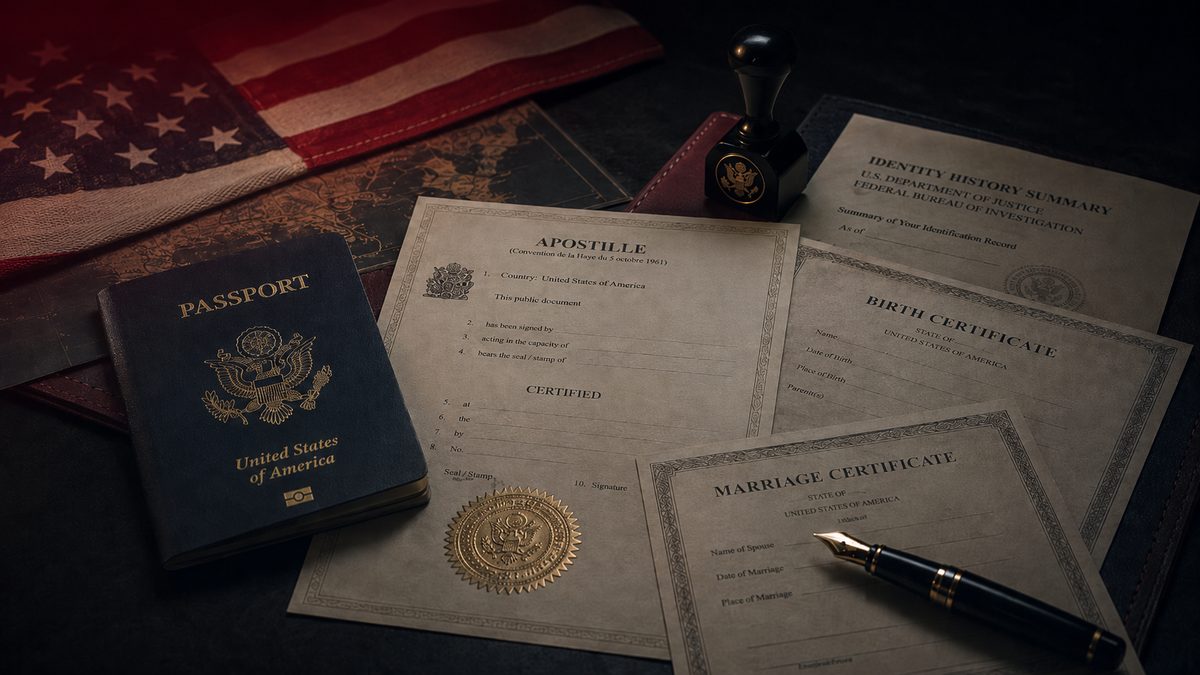
If you are American and applying for residency abroad, sooner or later someone will ask for an apostille.
That might be a birth certificate for Mexico, a marriage certificate for Panama, an FBI background check for Paraguay, or a notarized power of attorney for a lawyer handling the file. The request sounds simple until you discover the United States does not have one apostille office for everything.
The U.S. has a split system. Some documents go to a state Secretary of State. Some go to the U.S. Department of State. Some need a county clerk or court certification before the state will touch them. And the FBI background check, which is one of the most common residency documents, is where many Americans send the file into the bureaucratic ditch.
Here is the plain-English version.
What Is an Apostille?
An apostille is a certificate that verifies the signature, seal, or stamp on a public document so it can be recognized in another country that belongs to the Hague Apostille Convention.
It does not prove that every statement inside the document is true. It proves that the issuing official, notary, court clerk, or federal officer was legitimate and that the signature or seal can be relied on abroad.
For residency applications, apostilles are commonly requested for:
- Birth certificates
- Marriage certificates
- Divorce decrees and court records
- FBI Identity History Summary checks
- State or local police background checks
- Name change orders
- Diplomas and transcripts
- Notarized passport copies
- Powers of attorney, affidavits, and sworn statements
- Bank, pension, or income letters when the destination country requires them
If the destination country is not part of the Apostille Convention, you may need an authentication certificate instead, followed by legalization through that country's embassy or consulate. The destination country decides which certificate is required. Naturally, because one stamp was not enough paperwork theatre.
State vs Federal Apostilles
The first question is not "Where do I get an apostille?" The first question is "Who issued the document?"
Documents issued by a U.S. state usually go through that state's Secretary of State or equivalent apostille authority. Federal documents usually go through the U.S. Department of State Office of Authentications.
State Apostille
Used for state-issued vital records, state court records, notarized private documents, many school records, and some local police records after the required state-level certification chain.
Federal Apostille
Used for federal documents such as FBI Identity History Summary checks, certain federal agency records, Consular Reports of Birth Abroad, naturalization-related records, and other documents signed by a federal official.
The practical read: Do not send everything to Washington because it feels more official. Do not send everything to your state because it is cheaper or faster. Match the apostille office to the issuing authority.
Quick Rule: State Document or Federal Document?
If the document was issued by a state, county, local court, school, or state/local official, start with that state's apostille authority.
If the document was issued by a federal agency, such as the FBI, start with the U.S. Department of State Office of Authentications.
If the document was notarized, the apostille path usually follows the state where the notarization happened, but some states require county clerk certification before the Secretary of State will issue the apostille.
Documents That Usually Go to the Secretary of State
Most everyday residency documents are state documents. They usually go to the Secretary of State in the state where the document was issued, notarized, or certified.
Common examples include:
- Birth certificates issued by a state vital records office
- Marriage certificates issued by a state, county, or local vital records authority
- Divorce decrees from a state court
- Name change orders from a state court
- State or local police clearance letters, depending on the state process
- Notarized copies of passports, IDs, affidavits, powers of attorney, and similar private documents
- School transcripts or diplomas after the required notarization or registrar certification
For vital records, do not assume an old photocopy from the family drawer will work. Many states require a recent certified copy with the proper registrar signature, seal, and issue information. Some foreign immigration offices also impose their own freshness rules even if the U.S. document itself does not expire.
For court documents, some states require a certified copy from the court before the Secretary of State can issue the apostille. For county-issued records, some states require an intermediate county clerk certification first. That is the little administrative landmine that turns a two-week plan into a five-week apology email.
Documents That Go to the U.S. Department of State
Federal documents generally go to the U.S. Department of State Office of Authentications.
For residency-abroad work, the most important federal document is the FBI Identity History Summary, often casually called an FBI background check. Other federal documents may include certain records from federal agencies, Consular Reports of Birth Abroad, and some naturalization or citizenship records, depending on the document and signature.
The Department of State says it issues apostille certificates and authentication certificates, with the country where the document will be used determining which certificate you receive.
For Department of State authentication requests, you generally prepare the document, complete Form DS-4194, include the fee and return mailing information, and submit the package by mail or through the available in-person process if eligible. Processing and intake rules can change, so check the current State Department page before mailing anything valuable.
The FBI Background Check Apostille Trap
This is the big one.
Many residency programs want a federal criminal background check. In the United States, that usually means the FBI Identity History Summary. Because the FBI is a federal agency, the apostille normally comes from the U.S. Department of State, not from a state Secretary of State.
The FBI says it does not provide apostilles. It authenticates fingerprint search results with an FBI watermark and the signature of a division official, and the requester can then send the authenticated FBI document to the U.S. Department of State for an apostille if necessary.
That means a state apostille on a notarized copy of an FBI report may not solve your problem. The foreign authority asked for a federal background check. A state notary stamp does not magically turn a federal record into a state document. Nice try, but bureaucracy rarely rewards creativity.
For residency purposes, confirm:
- Whether the destination country wants a federal FBI report or a state/local police clearance
- How recent the background check must be
- Whether the apostille must be federal
- Whether the country accepts an electronically delivered FBI result printed and mailed for apostille
- Whether a certified translation is required after the apostille is attached
If you are building a serious residency file, treat the FBI report as a separate timeline. It is often the document that determines whether the rest of the packet arrives on time.
Notarized Documents and County Clerk Certification
Private documents usually need notarization before they can be apostilled. That can include affidavits, powers of attorney, passport copies, financial letters, permission forms, and certain school or employment documents.
But notarization is not always the final step before the apostille. In some states, the Secretary of State can verify the notary directly. In others, the document may first need county clerk certification confirming the notary's commission. Some court or municipal records may need a court clerk, county clerk, or other local official to certify the signature before the state will issue the apostille.
Before signing anything, check the apostille instructions for the state where the document will be notarized. Make sure the notary uses acceptable wording, includes the venue, date, commission details, signature, and seal, and does not leave blank spaces that cause the package to be rejected.
If you are outside the United States, be extra careful with remote online notarization. Some states allow it in limited circumstances, but the foreign receiving authority may not like it. The State Department advises checking with both the U.S. state and the foreign country if you are abroad and trying to use a U.S. state notarization.
Timelines and Mailing
Do not plan apostilles around the best-case timeline. Plan around the slow document.
For state apostilles, timelines vary widely. Some states offer walk-in, counter, or expedited service. Others are mail-only or slower during heavy periods. Fees also vary by state and by document type.
For U.S. Department of State authentications, the official site currently lists mail-in processing in the multi-week range, with timelines and appointment rules subject to change. Add mailing time both directions, and remember that an FBI report may also have its own request and fingerprint timeline before the apostille package even starts.
Use tracked shipping. Include the right form, payment, document count, destination country, and return label. Keep scans of everything before mailing originals. If you are abroad, confirm whether the office will return documents internationally or whether you need a U.S. address, courier label, or trusted helper.
Common Mistakes Americans Make
The biggest mistake is sending a federal document to a state apostille office, especially the FBI background check.
Other common mistakes include:
- Sending a photocopy instead of a certified vital record
- Using the wrong state's apostille office
- Assuming notarization alone is the same as an apostille
- Skipping county clerk certification where the state requires it
- Using an old document when the foreign authority requires a recent issue date
- Forgetting Form DS-4194 for federal Department of State requests
- Failing to list the destination country correctly
- Removing or separating the apostille certificate after it is attached
- Getting the apostille before confirming whether translation is required
- Waiting until the visa appointment is already booked
The apostille process is not difficult once the routing is clear. The pain comes from treating every document like it belongs in the same pile.
Build the Packet Backward
Start with the destination country's residency checklist, not with a generic internet list. The broader residency document checklist helps map the full packet. Then identify each document, who issued it, how recent it must be, whether it needs translation, and which apostille authority can authenticate it.
A practical American residency-abroad packet may include:
- Certified birth certificate
- Certified marriage certificate, if applicable
- Certified divorce decree, if applicable
- FBI Identity History Summary
- State or local police clearance, if requested
- Passport notarized copy, if requested
- Proof of pension, income, or savings
- School or professional documents, if relevant
- Certified translations, if required
Work backward from the appointment date and give the FBI document extra room. If the destination country has a three-month freshness rule for background checks, do not burn half that window by sending the report to the wrong office.
Bottom Line
For Americans applying for residency abroad, apostilles are not just a final stamp. They are a routing problem.
State documents usually go through the correct state apostille authority. Federal documents usually go through the U.S. Department of State. The FBI background check is the one to treat carefully, because it is common, time-sensitive, and often sent to the wrong place.
The apostille does not make you resident anywhere. It just helps keep your file from getting bounced because the right document carried the wrong certificate.
Sources for Publishing/Fact-Checking
- U.S. Department of State — Office of Authentications
- U.S. Department of State — Requesting Authentication Services
- U.S. Department of State — Criminal Records Checks
- U.S. Department of State — Notarial and Authentication Services Abroad
- USA.gov — Authenticate an Official Document for Use Outside the U.S.
- FBI — Identity History Summary Checks FAQ
- HCCH — Apostille Convention Status Table
Not Sure Which Residency Pathway Fits?
Apostilles are only useful once you know which country, pathway, and document list you are actually working toward.
The Exiled Mounty Field Guides help Americans map the document and residency issues that can slow the file down.
Educational information only. Not legal, immigration, tax, financial, or professional advice. Verify current requirements with official sources and qualified professionals before acting.