
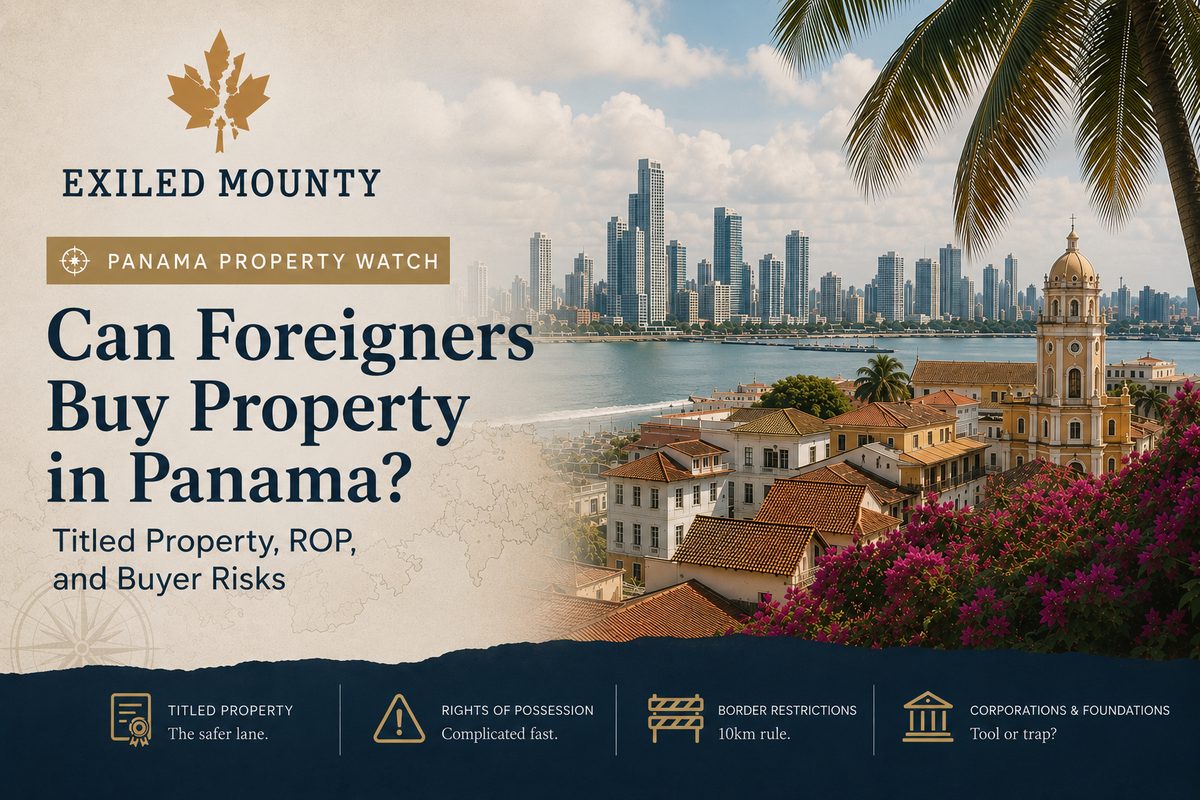
Direct answer: Foreigners can generally buy titled property in Panama with rights similar to local buyers. The important exceptions are the constitutional restriction near international borders and the much higher risk of Rights of Possession property. A buyer should confirm registered title, liens, boundaries, access, taxes, and seller authority before paying a deposit.
The Property Watch Version
Yes, foreigners can generally buy property in Panama.
That is the simple answer. It is also the answer most sales pages want you to stop at, because the next part is where the brochure starts sweating.
Panama is one of the easier Latin American countries for foreign buyers on paper. Foreign investors are generally treated much like local investors, and titled property can be bought, sold, inherited, financed, and registered through Panama's Public Registry system.
Fine. Good start.
Now put the brochure down and look at the file.
The question is not just whether Panama lets you buy property. It usually does. The question is what kind of property someone is trying to sell you, how clean the record is, and whether you can still sell the thing when the romance wears off.
Panama separates the careful buyer from the man who thought the jungle parcel was cheap because he was clever.
The Short Answer
Foreigners can generally buy titled property in Panama with rights similar to Panamanian buyers, subject to Panamanian law.
The cleaner lane is titled property registered in Panama's Public Registry. That gives your lawyer something real to inspect: owner, description, transfers, liens, mortgages, and the legal trail that should exist before serious money changes hands.
The more complicated lane is Rights of Possession property, often called ROP or Derecho Posesorio. You see it more often with rural land, island parcels, coastal offers, and the sort of cheap acreage that makes normal people start imagining hammocks and bad decisions.
There is also a major constitutional restriction near Panama's international borders. Foreign individuals and foreign-owned entities cannot acquire land within 10 kilometers of the border.
Field note: Panama is open to foreign buyers. It is not open to lazy due diligence.
Titled Property Is The Cleaner Lane
If you are a foreign buyer looking at Panama, titled property is usually where you start.
Titled property means the ownership is formally recorded in Panama's Public Registry. A proper file should show who owns it, what is being transferred, how the property is described, and whether there are recorded mortgages, liens, embargoes, lawsuits, tax problems, or other legal headaches waiting in the tall grass.
It still needs work. A titled property can have bad boundaries. It can have access problems. It can have a seller who is not quite as clean as the listing implies. It can have a lovely terrace and a property file that looks like it was assembled during a power outage.
But titled property gives your lawyer a record to examine. That is the point. You want paper, maps, registry entries, taxes, access, use rights, and permits to line up with reality on the ground.
Nice photos do not cure a bad property file. Neither does a charming agent with perfect English and a linen shirt.
Rights Of Possession: Where Cheap Gets Expensive
Rights of Possession property is where many Panama deals become complicated fast.
ROP does not mean the same thing as clean registered title. It usually means someone has a recognized possessory claim or occupancy right over land that may not be fully titled in the ordinary Public Registry sense.
That can exist legally. It can also be complicated, slow, disputed, poorly documented, or misunderstood by foreign buyers.
You will often see ROP tied to rural land, island land, coastal land, Bocas del Toro-style listings, off-grid parcels, and cheap-acreage offers. The sales pitch is not hard to recognize.
Big land. Low price. Ocean nearby. Owner motivated.
Naturally, because paperwork never ruined a dream before breakfast.
Some ROP property may be legitimate. Some may even be worth pursuing for a buyer who understands the local history and has the stomach for the process. But it belongs in specialist territory. You need a serious Panamanian lawyer who understands that exact land type, that exact region, the titling history, the local claims, and the realistic path to resale.
Not a WhatsApp blessing. Not a cousin of the seller. Not a real estate agent forwarding a PDF and calling it diligence.
If a buyer cannot explain the difference between titled property and ROP, he has no business wiring a deposit.
The Border Restriction
Panama has a constitutional restriction on foreign ownership near its international borders. Foreign individuals, foreign legal entities, and Panamanian legal entities with foreign capital cannot acquire ownership of national or private land located less than 10 kilometers from the border.
That matters near Costa Rica and Colombia.
For most normal buyers looking at Panama City, Coronado, Boquete, David, Pedasi, or other common expat markets, this may not be the daily problem. But if a listing is rural, remote, cheap, or anywhere near a border region, the question belongs near the top of the file.
Do not assume "Panama allows foreigners to buy" means every parcel in Panama is available to foreigners.
That is how people turn a map into a legal problem.
Corporations And Foundations: Useful, But Not Magic
Many Panama property purchases are structured through a corporation or foundation. That may be common. It may even make sense.
Common is not the same as simple.
A corporation or foundation can affect privacy, estate planning, banking, control, reporting, taxes, annual fees, compliance, and the future sale of the property. For Canadians and Americans especially, foreign entity ownership can create home-country reporting issues. These are easy to ignore right up until the penalty letters start arriving with all the warmth of a frozen parking ticket.
Do not buy through a corporation because an agent says, "That is how everyone does it."
Ask who controls the entity. Ask who owns the shares or foundation interest. Ask what the annual fees and filings look like. Ask what happens if one spouse dies, if you sell, if the bank wants documentation later, or if your home-country tax authority decides your tropical retirement structure is suddenly very interesting.
Field note: Entity structures are tools, not fairy dust.
The Cheap Listing Is Not Always Cheap
Panama has real opportunities. It also has plenty of listings where the price is only the first invoice.
A cheap property can become expensive once the lawyer starts checking title, surveys, unpaid taxes, liens, permits, and ROP uncertainty. None of that looks dramatic in the listing photos. It just shows up later, usually after someone has already started saying things like "we can probably sort that out."
Then comes access. A road in the dry season may become a mud argument in the wet season. Water may be seasonal. Electricity may be nearby in the same way retirement is nearby when you are thirty-two. Septic, drainage, fences, easements, and access rights all deserve more attention than the drone video.
Use is another quiet trap. Can you build what you want? Are permits realistic? Are there condo rules, HOA rules, zoning restrictions, protected-area concerns, or resale issues that make the property less flexible than the sales pitch suggests?
And if you are managing land from another country, distance becomes its own invoice. Someone has to watch the fence, pay local bills, deal with repairs, stop encroachment, and explain why the neighbor now believes the driveway is communal.
Cheap land can be a bargain. It can also be a subscription to problems you do not live close enough to manage.
Panama Property Watch Rule
If the property is titled, registered, accessible, properly surveyed, legally usable, and independently reviewed, Panama may be one of the cleaner property markets in Latin America for foreign buyers.
If the file is thin, the property is remote, the price is oddly friendly, or the deal is being sold with trust me energy, slow down.
ROP, coastal land, island parcels, and cheap rural acreage are not automatic no-go zones. They are higher-friction zones. Different thing. Still important.
Do not fall in love with the listing before the file has survived legal review.
That is the little administrative discipline that saves people from buying a sunset with no exit plan.
Buyer Checklist
- Is it titled property or Rights of Possession?
- Is it registered in Panama's Public Registry?
- Who is the registered owner?
- Are there liens, mortgages, claims, lawsuits, taxes, or recorded restrictions?
- Is it within 10 kilometers of an international border?
- Are boundaries and surveys clear?
- Is legal access guaranteed?
- Are water, electricity, road access, and permits real?
- Is the purchase being made personally, through a corporation, or through a foundation?
- What does that structure create for tax, reporting, estate, and resale issues?
- Have you used an independent Panamanian lawyer who represents you, not the seller or developer?
If the answer to any of those is vague, the file is not ready.
Bottom Line
Foreigners can generally buy property in Panama.
That is not the trap.
The trap is assuming the legal permission to buy means the property itself is clean, titled, accessible, financeable, usable, and resaleable.
Panama can be a good property market for foreign buyers who respect the file. Titled property is usually the cleaner path. Rights of Possession belongs in the caution box. Corporations and foundations need real advice. Cheap land deserves extra suspicion, especially when everyone involved seems allergic to straight answers.
The question is not whether Panama lets foreigners buy. The question is whether the thing being sold is worth buying.
Sources For Publishing/Fact-Checking
- Panama Ministry of Commerce and Industries — Law 54 of 1998, Legal Stability of Investments
- Panama Digital / Registro Publico de Panama — Inscripcion de Propiedad
- Panama Constitution official site — Constitucion vigente
- FAOLEX — Panama Constitution PDF, including Article 291 border restriction
Educational information only. Not legal, real estate, tax, investment, immigration, or financial advice. Verify with qualified Panamanian professionals before acting.