
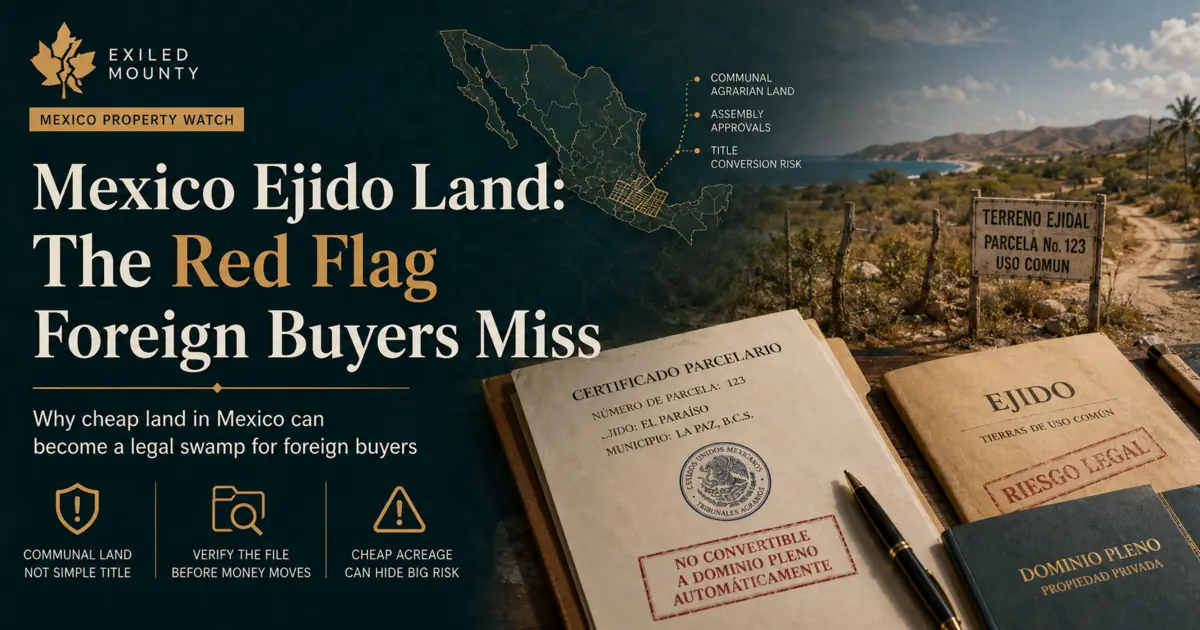
Direct answer: Ejido land is communal agrarian property, not ordinary private titled real estate. A foreign buyer should not pay for an ejido parcel based on possession, a private contract, or a promised future conversion. Treat the property as unbuyable until an independent Mexican property lawyer and notario verify that the full conversion and registration chain is complete.
Ejido land is one of the first property concepts foreign buyers need to understand in Mexico. It often appears around growing towns, beach corridors, rural roads, and future-development stories. It can look cheap compared with private titled property. That price gap is usually trying to tell you something.
An ejido is a form of communal agrarian land. It is not the same thing as ordinary private property. Rights may belong to ejido members, local assemblies, families, or possessors under agrarian rules. The path from communal land to private, sellable title is not a handshake process.
Mounty's read: If someone says "it is ejido, but it is basically fine," stop. That sentence has buried more foreigner money than bad crypto and beach tequila combined.
Why Ejido Land Is Different
Private titled property can usually be checked through the relevant public registry, notario process, cadastral records, tax records, and municipal documents. Ejido land lives in a different legal universe. Agrarian rights, assembly approvals, certificates, conversion steps, and registration history are important.
The danger is not that every ejido-related opportunity is automatically fraudulent, but that many buyers do not know what they are actually buying. They think they are buying land. They may actually be buying a promise, a possession right, or a future conversion story.
The Conversion Story
You will hear phrases like "dominio pleno," "regularization," "title soon," or "the paperwork is almost finished." Those may refer to real legal processes, but they are not magic words. The details matter: whether the ejido assembly properly approved the step, whether the parcel was individually certified, whether full domain was obtained, whether the change was registered, and whether the seller can legally transfer what is being offered.
If the property is not already clean private property with the transfer path verified by qualified professionals, assume the deal is not ready for foreign-buyer money.
Red Flags
The price is far below comparable private titled land, and the explanation is mostly confidence and vibes.
The seller says title, conversion, services, road access, or permits are coming soon.
You cannot get a clear notario-backed explanation of exactly what right is being transferred.
You are told to move fast because locals, developers, or other foreigners are about to buy everything.
Questions To Ask Before You Go Further
- Is the land private property or ejido/communal land?
- What document proves the seller has transferable rights?
- Has dominio pleno been obtained, if required?
- Where is the status recorded: agrarian records, public registry, cadastral records, or all of the above?
- Who approved the transfer, and was the approval legally sufficient?
- Can a qualified notario and independent lawyer explain the path in writing?
For Most New Expats, The Rule Is Simple
If you are new to Mexico, do not make ejido land your first purchase. Rent, scout, learn the market, build local professional contacts, and understand private titled transactions first. Rural land and communal land can be a specialist game. Beginners should not play specialist games with retirement money.
That is especially true if the pitch involves a beach corridor, a future highway, a coming airport, a "secret" growth area, or acreage that supposedly cannot lose. When the pitch is mostly story, the file needs more proof.
Sources And Verification Points
- Mexican Agrarian Law - official legal framework starting point: diputados.gob.mx/LeyesBiblio/pdf/LAgra.pdf
- Registro Agrario Nacional - official agrarian registry starting point: gob.mx/ran
- Verify the property file with a qualified Mexican lawyer, notario, and any relevant agrarian authority before acting.
Bottom line: Ejido land is not beginner terrain. If the file is not clean, written, verified, and boring, keep your wallet in its holster.
Educational information only. Not legal, real estate, tax, investment, immigration, or financial advice. Verify with qualified Mexican professionals before acting.