
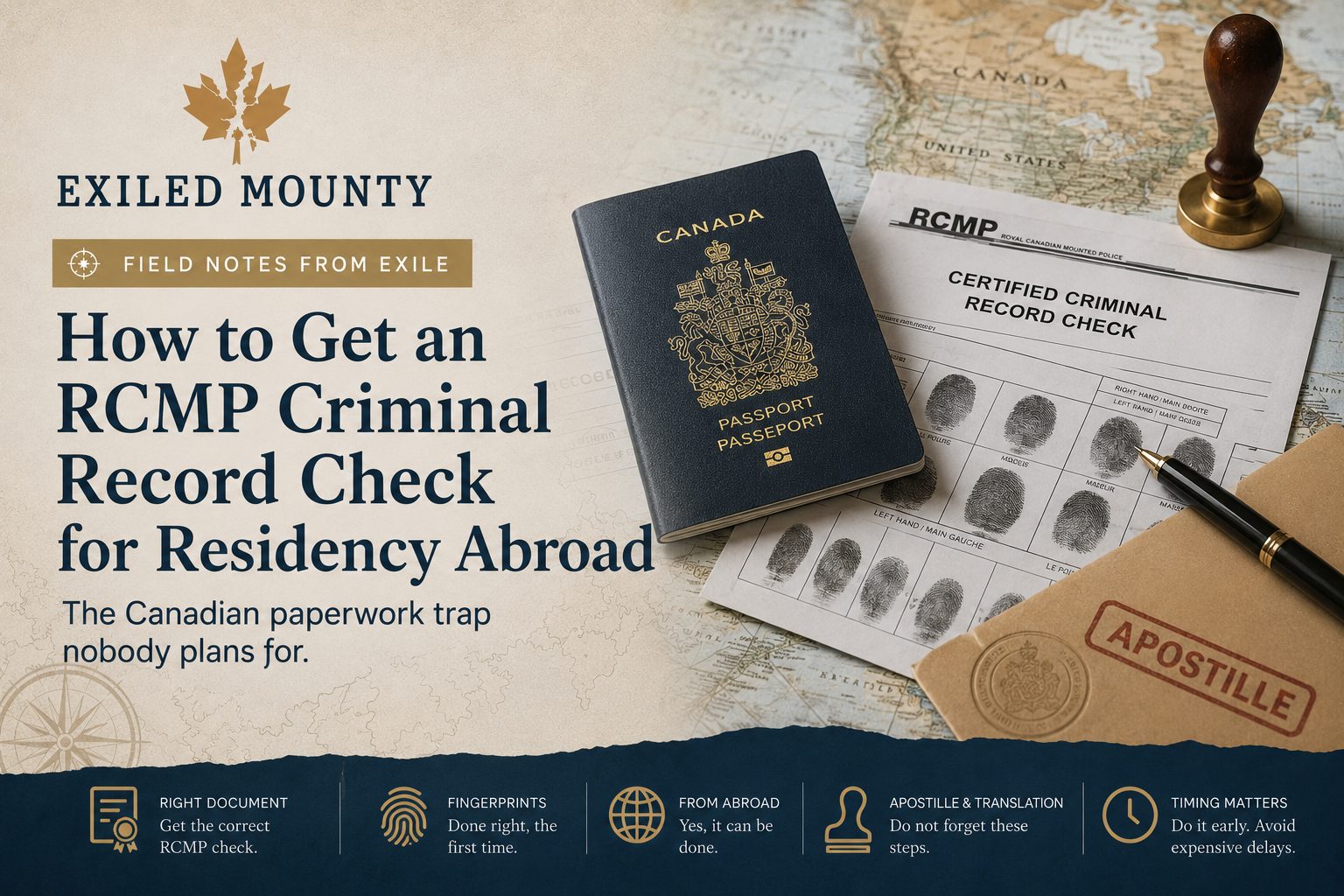
Direct answer: Canadians applying for immigration, residency or a visa abroad are often asked for a fingerprint-based RCMP Certified Criminal Record Check. Depending on the destination, the Canadian document may also need an apostille and a certified translation before it will be accepted. Canadians already living overseas can still obtain the check by having fingerprints taken locally and submitting them through an RCMP-accredited Canadian fingerprinting company. Confirm the destination authority's exact document type, issue-date window, apostille and translation rules before ordering.
For residency abroad, the criminal record check is not a small errand.
It is part of the document chain that can make or stall the file.
Most Canadians think the hard part of moving abroad is choosing the country.
Wrong.
The hard part is usually convincing three different bureaucracies that you are not a criminal, your birth certificate is real, your fingerprints belong to you, and the Canadian document you brought is still fresh enough to be useful.
Welcome to the criminal record check file.
If you are applying for residency abroad, especially in Latin America, there is a good chance someone will ask for a Canadian police clearance, background check, RCMP certificate, criminal record check, or some local version of those words.
They do not always mean the same thing.
That is where people get into trouble.
People order the wrong version. Some skip fingerprints. Others get a local police check when the foreign authority wanted the RCMP version. The apostille gets overlooked. Then the process drags on too long, and the document expires before the residency appointment.
Then the whole plan stalls because one Canadian form is sitting somewhere between Ottawa, a courier depot, and bureaucratic purgatory.
The Short Version
For most serious residency-abroad applications, the document people usually need is a fingerprint-based RCMP Certified Criminal Record Check.
For residency files, this usually means the RCMP-certified fingerprint-based version rather than a basic name-based search, a vulnerable sector check, or a local police letter, unless the foreign authority specifically says one of those alternatives is acceptable.
A name-based check may be faster.
That does not make it accepted.
For Latin American residency applications, the fingerprint-based RCMP version is usually the safer starting assumption.
The RCMP’s certified criminal record check uses fingerprints to verify identity and search Canada’s national criminal-record repository. For immigration, visa, foreign travel, residency, or work-abroad purposes, you usually want the RCMP application type tied to immigration and travel.
The word usually is doing work here.
Every country has its own checklist. Every consulate has its own interpretation. Every immigration lawyer has a story about the applicant who showed up with the wrong document and a hopeful smile.
The receiving authority wins.
Always check the exact requirement for the country where you are applying.
Quick Start Checklist
If you are applying for residency abroad and need a Canadian police clearance, start here:
- Confirm the exact document required by the destination country.
- Assume you may need a fingerprint-based RCMP Certified Criminal Record Check unless told otherwise.
- Get fingerprints taken through a police service or RCMP-accredited fingerprinting company in Canada, or through an authorized agency abroad.
- Make sure the RCMP result is requested under the correct purpose, usually immigration, visa, foreign travel, residency, or work abroad.
- Apostille or authenticate the document if the destination country requires it.
- Translate it if the destination country requires Spanish or another local language.
- Submit it before the country’s document freshness window expires.
That is the working sequence.
The rest of this guide explains the traps.
The Version Problem
This is the first trap.
People ask:
“How do I get a criminal record check?”
The better question is:
Which criminal record check does the foreign immigration office actually want?
Canada has several types of checks, and they are not interchangeable.
A local police check may be fine for some domestic purposes. A vulnerable sector check is usually for work or volunteering with vulnerable people in Canada. A name-based check may be fast, but many foreign residency offices want something stronger.
For residency abroad, the safer starting assumption is that you may need the RCMP certified fingerprint-based version unless the destination country clearly says otherwise.
Easy is not the same as accepted.
That sentence will save people a lot of grief.
Some countries may also ask for additional local, national, or international checks beyond the standard RCMP document, so always follow the destination country’s checklist.
Do You Need Fingerprints?
If the document required is an RCMP Certified Criminal Record Check, yes.
That is the point of the document.
Some countries may accept a name-based check, but fingerprint-based is the safer default for residency applications.
Inside Canada, you can usually go through a local police service or an RCMP-accredited fingerprinting company.
Outside Canada, it can still be done, but the process has more moving parts.
The RCMP says applicants outside Canada can submit an application for a certified criminal record check, but first they need fingerprints taken. Then the application must go through an accredited fingerprinting company.
The fingerprint form needs to be done properly:
- prints of all ten fingers
- black ink
- name and address of the authorized agency
- signature and name of the official who took the fingerprints
- clear, readable prints
Then the fingerprints are sent to an RCMP-accredited fingerprinting company in Canada. That company converts the paper prints into digital format and submits the application electronically to the RCMP.
Do not just mail fingerprints directly to the RCMP and hope for the best.
The RCMP says that will not be accepted.
Which is government-speak for: enjoy starting over.
Can You Do It From Abroad?
Yes, but plan for friction.
If you are already outside Canada, you are not automatically stuck. In many cases, fingerprints can still be taken locally and submitted through a Canadian accredited fingerprinting company.
But you need to think through the whole chain:
- Where can I get proper ink fingerprints taken locally?
- Will the official sign and identify the agency properly?
- Which Canadian company will accept the paper prints?
- Where will the RCMP result be mailed?
- Does the document need apostille or authentication?
- Does it need translation?
- How long will couriers take?
- Will the document still be fresh when I submit it?
This is where people lose time.
Not because the concept is complicated.
Because the file has too many handoffs.
If you are still in Canada and know you may apply for residency abroad, start early.
Future-you, standing in a hot country with courier problems and a foreign appointment date closing in, will appreciate it.
For broader document planning, this is where the Canada Apostille Guide becomes useful. The RCMP check is usually just one document in the stack.
How Long Does It Take?
The RCMP says that if there is no match to a criminal record, electronic fingerprint submissions can be processed quickly.
But that is not the full timeline.
The results are mailed to the address provided, and delivery time is separate. If manual processing is required, if the application is incomplete, or if there is a possible match, the file can take longer.
The mistake is budgeting only for the RCMP processing time.
You also need to account for:
- fingerprint appointment time
- fingerprint company processing
- RCMP processing
- mailing time
- apostille or authentication
- courier time
- translation
- appointment scheduling abroad
Some countries also require the police check to be issued within a recent window, often three or six months.
That means you cannot order it too late.
You also cannot order it too early.
Lovely system. Very Canadian. Builds character, apparently.
Does It Need an Apostille?
Often, yes, though some countries do not require an apostille for an RCMP criminal record check.
Canada is now part of the Apostille Convention. That means Canadian public documents used abroad may be authenticated with an apostille for countries that also participate in the convention.
An apostille does not mean the foreign country agrees with the content of the document.
It means the Canadian signature, seal, or authority behind the document has been authenticated for foreign use.
For residency abroad, many countries want foreign public documents apostilled. That can include:
- criminal record checks
- birth certificates
- marriage certificates
- divorce documents
- education records
- other civil documents
The catch is that not every Canadian document goes to the same apostille office.
For federal documents like an RCMP criminal record check, Global Affairs Canada is usually the relevant apostille/authentication authority.
Provincial documents are different. Birth certificates, marriage certificates, divorce documents, notarized copies, and other provincial records may need to go through a provincial competent authority, depending on the document and where it was issued or notarized.
If you are outside Canada, there may also be a Canadian embassy, high commission, or consulate option for authenticating certain documents, including original RCMP criminal record checks. Do not assume. Confirm with the mission first.
Do not guess.
Use the official Canadian apostille instructions before sending documents anywhere.
Guessing with apostilles is a good way to donate weeks of your life to a paperwork furnace.
If you are not sure where the apostille step fits, read the Canada Apostille Guide before mailing anything.
Does It Need Translation?
If the destination country operates in Spanish, assume translation may be required unless the immigration authority says otherwise.
But there are two separate translation questions:
- Does Canada need a translation to apostille or authenticate the document?
- Does the foreign country need a translation to accept it?
Those are not the same question.
An RCMP criminal record check is normally in English or French, so the Canadian apostille side may not need translation.
The destination country is different.
Mexico, Paraguay, Panama, Argentina, and other Spanish-speaking countries may require a Spanish translation by an approved, certified, sworn, or locally recognized translator.
The apostille itself may need translation as well.
In many cases, translation happens after the apostille is issued.
A local lawyer or immigration professional may coordinate that step, depending on the country.
Do not freestyle the order.
Ask the lawyer, consulate, or immigration authority what they want.
The usual sequence looks like this:
- RCMP check
- Apostille or authentication
- Translation
- Possible notarization or certification of translation
- Submission before the document expires
One wrong step and the document can be real but still useless.
That is the kind of nonsense bureaucracy specializes in.
Using an RCMP Criminal Record Check in Mexico
A Canadian-issued RCMP Certified Criminal Record Check and a Mexican-issued federal criminal record certificate are different documents for different files. If a Mexican consulate, immigration office, or other receiving authority asks for your Canadian police clearance, this RCMP guide is the relevant starting point. Confirm whether the Canadian check must be fingerprint-based, apostilled in Canada, translated into Spanish, and issued within a particular time window.
If you instead need a criminal record certificate issued by Mexico—for example, because you are a foreign resident of Mexico and another country has asked for your Mexican record—use the separate guide to getting and apostilling a Mexican federal criminal record certificate.
The Abroad Checklist
If you are outside Canada and need an RCMP check for residency abroad, think in terms of handoffs:
- Confirm the destination country wants an RCMP fingerprint-based check.
- Get proper ink fingerprints taken by an authorized local agency.
- Send the prints to an RCMP-accredited company in Canada.
- Have the company digitize and submit them to the RCMP.
- Confirm where the RCMP result will be mailed.
- Apostille or authenticate the result if required.
- Translate it if required.
- Submit it before the destination country’s freshness window expires.
That is the file: not hard, just unforgiving.
Where This Fits in a Residency Plan
The criminal record check is rarely the only document.
It usually sits beside other documents:
- birth certificate
- marriage certificate
- divorce certificate or judgment
- passport copies
- proof of income
- bank statements
- proof of address
- health insurance documents
- passport photos
- apostilles
- translations
This is why the RCMP check should not be treated as a one-off errand.
It is part of the residency file.
If you are looking at Mexico, pair this with the Mexico Residency Guide so you understand how financial proof, consulate appointments, and document timing fit together.
If you are looking at Paraguay, pair this with the Paraguay Residency Starter Guide so you understand the wider document stack before you start ordering papers.
If you are not sure which route fits you, use the Plan of Attack residency assessment before you start spending money on documents you may not need yet.
The goal is not to collect paperwork like a bored squirrel.
The goal is to build the right file for the right country in the right order.
Mounty’s Read
The criminal record check is one of those documents that separates serious Plan B work from daydreaming.
Everybody likes talking about beaches, cheap rent, taxes, and freedom.
Fine.
But the real move happens in the documents.
Can you prove who you are?
Can you prove your record?
Can you get Canadian paperwork accepted by a foreign government?
Can you do it before the document expires?
That is the boring machinery behind a working exit plan.
If you are still in Canada and even thinking about residency abroad, learn this process now.
If you are already abroad, do not panic, but do not wing it either.
A clean Plan B is not just picking a country.
It is building a document trail boring enough that a foreign immigration officer has nothing interesting to say about it.
That is the goal.
Boring documents. Clean file. More exits.
Related Field Guides
- Canada Apostille Guide — for apostille and authentication rules before sending Canadian documents abroad.
- U.S. Apostille Guide — for American documents used in residency files abroad.
- Plan of Attack — for identifying the residency route and document stack that fits your facts.
- Mexico Residency Guide — for Canadians planning a Mexico temporary or permanent residency file.
- Paraguay Residency Starter Guide — for Canadians considering Paraguay residency and document preparation.
Sources
- RCMP: Criminal record checks — rcmp.ca/en/criminal-records/criminal-record-checks
- RCMP: Where to go for fingerprint-based criminal record checks — rcmp.ca/en/criminal-records/criminal-record-checks/where-go
- RCMP: Types of certified criminal record checks — rcmp.ca/en/criminal-records/criminal-record-checks/types-certified-criminal-record-checks
- RCMP: Processing times and fees — rcmp.ca/en/criminal-records/criminal-record-checks/processing-times-and-fees
- RCMP: Private fingerprinting companies accredited by the RCMP — rcmp.ca/en/criminal-records/criminal-record-checks/private-fingerprinting-companies-accredited-rcmp
- Global Affairs Canada: Authentication of documents / apostille — international.gc.ca/gac-amc/about-a_propos/services/authentication-authentification/index.aspx?lang=eng
Educational information only. Not legal, immigration, tax, financial, or professional advice. Verify document requirements with official sources, the receiving authority, and qualified professionals before acting.