
Most people think the hard part of moving abroad is choosing the country.
The country choice is real work. Mexico, Paraguay, Belize, Panama, Costa Rica, and other Plan B destinations are not interchangeable flags on a map. They have different laws, different consulates, different immigration offices, and different levels of bureaucratic patience.
In real residency files, many applications succeed or stall because of paperwork. Not because the dream was impossible, but because the criminal record check was too old, the marriage certificate was the wrong version, the apostille came from the wrong office, or the translation happened in the wrong order.
Residency paperwork is not exciting. Fine. Neither is a spare tire, until you need one on a dark road.
Different countries ask for different things, but the basic document stack is surprisingly consistent. If you understand the categories early, you can move faster when a real opportunity appears.
The Short Answer
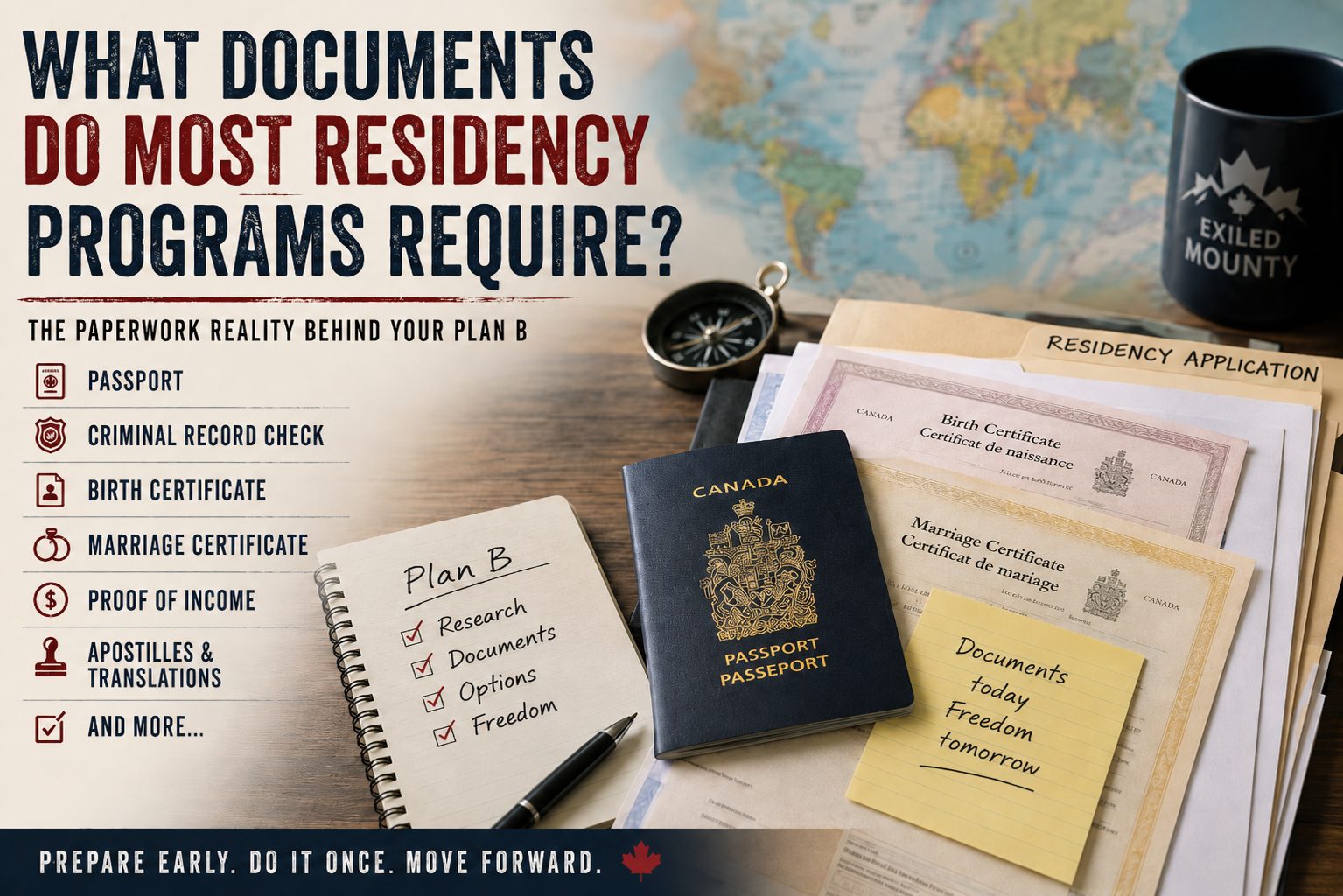
Most residency programs eventually ask for some variation of:
- Passport
- Criminal record check or police clearance
- Birth certificate
- Marriage certificate (if applicable)
- Divorce documents (if applicable)
- Proof of income or savings
- Passport photos
- Apostilles or authentication/legalization
- Translations
The exact mix changes by country. The categories usually do not.
Passport
Your passport is the anchor document. It proves identity, nationality, legal name, and travel eligibility. Most residency programs require a valid passport, copies of the bio page, and sometimes copies of entry stamps or prior visas.
The common mistake is waiting until the passport is almost expired. Many countries want a passport valid for a minimum period beyond the application date. Airlines and border officials may also care. If your passport has less than a year left, fix that before building a serious file.
Name consistency matters. If your passport, birth certificate, marriage certificate, bank statements, and criminal record check use different names, the file may need extra proof connecting them. Bureaucracy does not enjoy your life story. It enjoys matching names.
Criminal Record Checks
Most residency programs want proof that you are not arriving with a serious criminal record. The wording varies: criminal record check, police clearance, police certificate, background check, certificate of good conduct, or national police certificate.
For Canadians, that may mean a fingerprint-based RCMP Certified Criminal Record Check. The RCMP Criminal Record Check Guide explains the Canadian version in detail, including fingerprints, apostilles, translations, and timing.
A Canadian-issued RCMP check is different from a certificate issued by Mexico. Foreign residents who need proof of their Mexican record should use the Mexican federal criminal record certificate and apostille guide.
For Americans, many residency files use the FBI Identity History Summary. A separate FBI background check guide belongs in this cluster because the FBI document usually follows a federal apostille path through the U.S. Department of State, not a state apostille office.
The timing problem is brutal here. Criminal checks often have freshness windows: 30 days, 90 days, three months, six months, or another country-specific rule. Order it too early and it expires. Order it too late and everything else waits on it. Lovely system. Builds character, apparently.
Birth Certificates
Birth certificates help prove identity, parentage, place of birth, and legal name. Some countries only need them for dependent children or family routes. Others ask for them in the main residency file.
Do not assume an old wallet card, hospital record, baptism certificate, or decorative family copy will work. Many countries want an official civil birth certificate from the issuing authority, often a long-form version. If the document is laminated, damaged, or missing the right seal or signature, order a fresh copy.
Birth certificates are usually less time-sensitive than criminal checks, but they may still need apostille and translation. Start early, especially if the issuing province, state, or registry is slow.
Marriage Certificates
Marriage certificates matter when a spouse is included in the residency file, when a dependent relationship must be proven, or when the route itself depends on marriage to a citizen or resident.
The mistake is using the ceremonial certificate from the wedding day instead of the official civil marriage certificate. The version with nice calligraphy and emotional value may be useless to immigration. Cold, yes. True, also yes.
If a spouse is included, expect questions about whether both applicants need separate files, whether one can be added as a dependent, whether income thresholds increase, and whether both people need police checks, apostilles, translations, and photos.
Divorce Records
Divorce documents may be needed to prove current civil status, especially if you are remarrying, applying with a new spouse, or using a family-based route.
Some countries want a divorce decree. Others may ask for a certificate of divorce, judgment, or final court order. The exact document depends on the issuing country and the destination country.
Common mistakes include using an incomplete court printout, missing the finality date, failing to apostille the court-certified copy, or translating the wrong document. Court records can be slow, so do not leave this for the week before an appointment.
Proof of Income
Many residency programs want to know how you will support yourself. Depending on the route, proof of income may include pension letters, Social Security statements, CPP/OAS records, employment letters, client contracts, invoices, tax returns, bank deposits, rental income records, or business documentation.
Mexico's economic-solvency route is a classic example where consular thresholds, account statements, and income proof matter. If Mexico is on your list, pair this article with the Mexico Residency Guide.
Income documents are tricky because they may not be standard government records. Some offices accept bank statements. Some prefer pension letters. Some want official statements over a set number of months. Some care whether income is net, gross, taxable, foreign-source, recurring, or deposited into the same account. This is where guessing gets expensive.
Proof of Savings
Some programs let applicants qualify through savings or investment balances instead of monthly income. This may require bank statements, brokerage statements, certificates of deposit, fixed-term deposits, or other financial records.
Watch the statement period. A country may want three months, six months, twelve months, or a specific average balance. A screenshot from your banking app is usually not a serious document. The file may need official statements with your name, account number, institution details, currency, dates, and balances.
If the account is joint, held through a company, held in a trust, or spread across multiple institutions, expect more questions. Immigration offices like simple. Life rarely cooperates.
Passport Photos
Passport photos sound simple until a country wants a specific size, background color, head position, finish, or number of copies.
Do not assume standard Canadian, U.S., or UK passport photos automatically match the destination country's residency format. Some countries require local photos taken after arrival. Others accept photos brought from abroad if they match the instructions.
This is a small item, but small items can still bounce a filing packet. It is undignified to lose a day because your head was two millimeters too large in a photo, but immigration has done worse things to better people.
Medical Documents
Some countries require medical certificates, health checks, lab tests, proof of vaccinations, or physician letters. Others do not ask for medical documents for the main residency route.
Where medical documents are required, timing matters. They may need to be recent, issued by an approved doctor, completed in the destination country, or translated. Do not order medical paperwork before checking the route-specific instructions. Medical documents are one of the easiest places to do the right task at the wrong time.
Translations
If the destination country uses Spanish, Portuguese, or another local language, foreign documents may need translation. For Latin America, Spanish translation is common.
The key question is not just "Does this need translation?" It is "Who is allowed to translate it, and when?"
Some countries require a locally registered public translator. Some accept sworn translators abroad. Some require the apostille to be translated too. In many files, the sequence is document first, apostille second, translation third. Translate too early and you may have to translate again after the apostille is attached. Very efficient, if your goal is paying twice.
Apostilles
An apostille is the certificate that lets a public document be recognized in another country that belongs to the Hague Apostille Convention. If the destination country is not in the convention, the process may involve authentication and consular legalization instead.
This article is not the full apostille lecture. That way lies madness and government terminology. For the practical country-specific routing, use the Canada Apostille Guide or the U.S. Apostille Guide.
The main rule: apostille routing follows the issuing authority. Federal documents often follow a federal path. State or provincial documents usually follow a state or provincial path. Notarized copies may follow the notary's jurisdiction. Sending everything to the same office because it feels tidy is how tidy people lose weeks.
The Document Timing Problem
Many people gather documents too early. Others wait too long. Both can hurt the file.
Birth and marriage certificates may be stable, though some countries prefer recently issued copies. Criminal record checks are usually more sensitive. Bank statements may need a specific date range. Medical documents may have short windows. Translations may need to happen after apostille. Some Paraguay-side or destination-country documents may only be obtained after entry or during the local filing sequence.
A serious residency file is not just a pile of documents. It is a sequence.
The better way is to work backward from the intended filing date. Identify which documents are slow, which documents expire, which documents need apostille, and which documents need translation after apostille. Then build the file in an order that keeps everything valid.
Why Apostille Routing Delays Files
Apostilles are where early-stage applicants often discover that documents are not just documents. A Canadian RCMP record, an Ontario birth certificate, an Iowa notarized affidavit, a U.S. FBI background check, and a UK civil record may all follow different routes.
For Canadians, start with the Canada Apostille Guide.
For Americans, start with the U.S. Apostille Guide.
For UK citizens, the same principle applies: identify the issuing authority, confirm the current legalization/apostille route, then check what the destination country wants done after that.
The Criminal Record Check Problem
Police clearance documents are often the document that controls the clock.
Canadians should understand the difference between local police checks and the RCMP-certified fingerprint-based version. The RCMP Criminal Record Check Guide is the deeper Canadian starting point.
Americans should understand the difference between state/local police checks and the FBI Identity History Summary. The future FBI guide should live beside this article, because U.S. applicants regularly lose time by sending FBI documents through the wrong apostille route.
Whatever your nationality, confirm the freshness window before ordering. A perfect police check that expires before filing is just expensive stationery.
The Document Stack Is Different For Every Country
The document categories are similar, but the mix changes by country and route.
Mexico
Mexico often starts at the consulate for temporary residency, especially economic solvency routes. The early document focus may be passport, financial proof, application forms, photos, and later canje documents in Mexico. Read the Mexico Residency Guide before guessing at the packet.
Paraguay
Paraguay Temporary Residence can involve foreign civil records, criminal/background records, apostilles, Spanish translations, sworn declarations, entry proof, and Paraguay-side certificates. The Paraguay Residency Starter Guide gives the broader sequence.
Belize
Belize routes can involve police records, medical or health-related documents, financial proof, passport copies, photos, and program-specific forms depending on whether the applicant is looking at QRP or another route.
Panama
Panama pathways often turn on route-specific proof: pension income, fixed deposits, investment evidence, professional handling, apostilles, translations, and a local filing sequence. The document stack depends heavily on the route.
The Residency File Checklist
Use this as a working checklist, not a country-specific filing packet:
- Valid passport
- Passport bio-page copies
- Entry stamp or proof of lawful entry, if applying in-country
- Criminal record check or police clearance
- Birth certificate
- Marriage certificate, if applicable
- Divorce record, if applicable
- Name change record, if applicable
- Proof of income
- Proof of savings or investments
- Tax returns or employment/business records, if requested
- Passport photos in the required size
- Medical documents, if required
- Apostilles, authentication, or legalization
- Certified or sworn translations
- Copies and digital backups
- Country-specific forms
- Fee receipts or payment proof
Do not treat this as legal advice or a complete filing list. Treat it as the map of the usual terrain.
Mounty's Read
People spend months debating countries. They compare beaches, tax rumors, YouTube videos, crime headlines, weather, and whether the local coffee will offend their personality.
Very few spend time understanding documents.
But the paperwork often determines how quickly a Plan B becomes real. A person with a current passport, fresh civil records, a plan for police checks, apostille routing understood, and translation rules mapped can move when the window opens. A person with mystery documents in a shoebox is still researching while the first person is booking appointments.
The point is not to order every document tomorrow. Some documents expire. Some should wait until the route is clearer. The point is to understand the stack early enough that you are not starting from zero when the country, route, or opportunity finally makes sense.
If you already know the country, use the country guide. If you are still choosing, use to screen the route before you spend money collecting paperwork you may not need.
Next Step
If you are Canadian, start with the Canada Apostille Guide and the RCMP Criminal Record Check Guide.
If you are American, start with the U.S. Apostille Guide and watch for the future FBI background check guide.
If you are comparing destinations, read the Mexico Residency Guide, the Paraguay Residency Guide, or use to turn your facts into a practical Plan of Attack.
Educational information only. Not legal, immigration, tax, financial, or professional advice. Residency programs and document rules change. Verify current requirements with official sources, consulates, immigration offices, and qualified professionals before acting.